Multi-Omics & Rhythm
The Missing Timestamp
Why multiomics without rhythm only tells half the story
We can measure biology with unprecedented precision: genes, proteins, metabolites, microbiome profiles, inflammatory patterns, and wearable signals.
But one question is still forgotten surprisingly often: When did this value emerge?
A cortisol value at seven in the morning tells a different story than the same value at ten at night. A glucose rise after breakfast does not mean the same thing as the same rise after a late dinner. A marker after a broken night is not simply your inflammation status. It is also the signature of a body that did not regenerate.
The body is not a still image
Multiomics gives us high-resolution maps. Yet many of these maps are still read as if the body were a static place with one fixed state that can be measured once and interpreted in isolation.
The body works differently. It is not a still image. It is a rhythm.
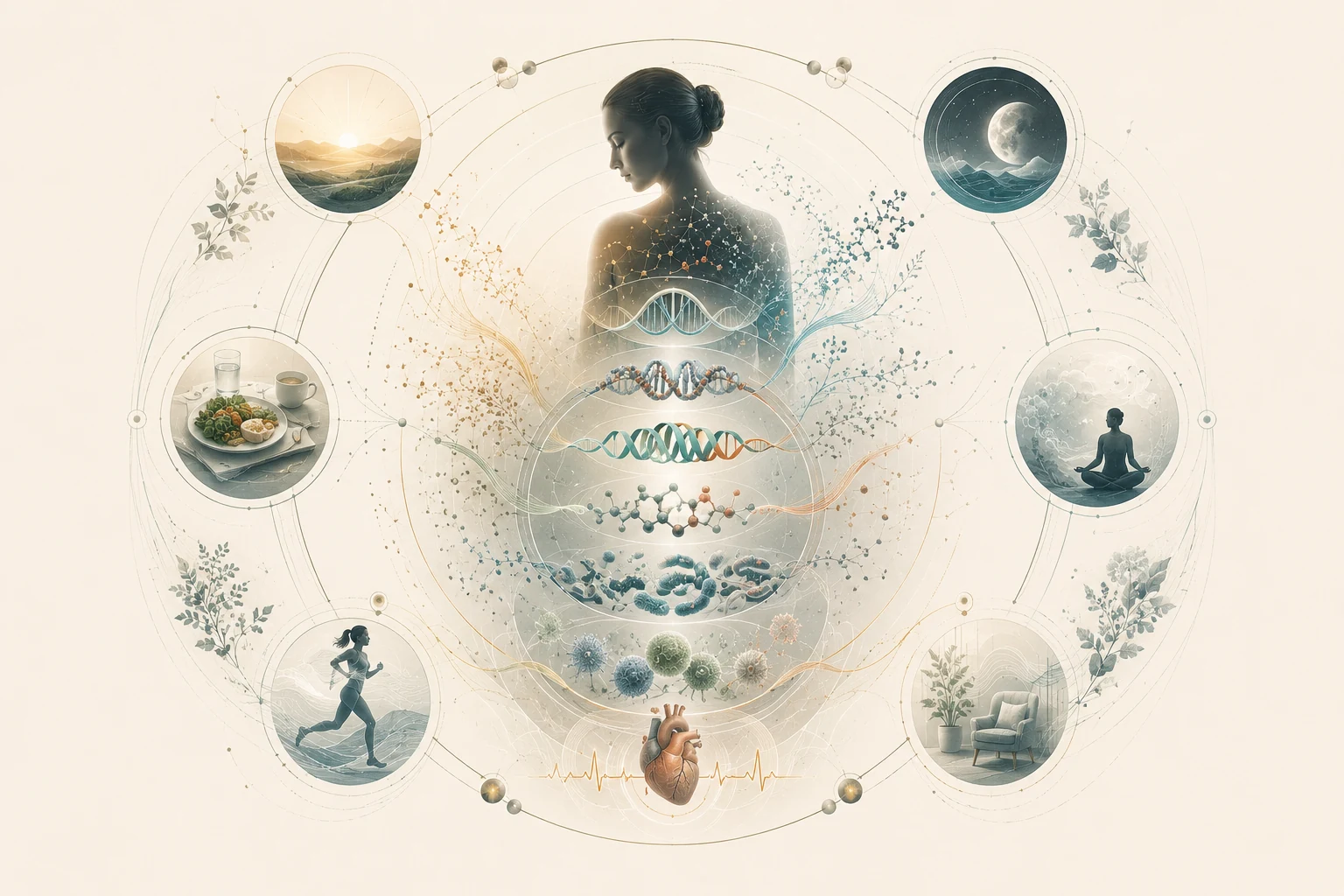
Hormones, immune cells, metabolic pathways, gut microbes, body temperature, sleep architecture, heart rate variability, and gene expression all change over time. A value is therefore never just a value. It is a value at a time.

The blind spot in modern diagnostics
We measure with increasing precision, but not always with enough rhythmic context. We ask what is elevated, what is reduced, and what lies outside the reference range.
Less often we ask whether the value fits the time of day, last night's sleep, the meal window, the light environment, the recovery state, the cycle, or the season.
This is where a different way of reading multiomics begins: not as isolated markers, but as the translation of a living system moving between activation and regeneration.
The metabolome reveals movement
The metabolome is especially rhythmic. Many metabolites fluctuate across the day. What is a plausible activation pattern in the morning may be a signal of missing recovery in the evening.
The same logic applies to cortisol, glucose, lipids, immune markers, and microbial metabolites. Without a timestamp, we may mistake a phase for a trait.
Precision begins with context
This does not make classical lab values or multiomics analyses less important. It makes them more important, because they become more interpretable.
The future of prevention is not simply collecting more data. It is connecting data to time, sleep, light, nutrition, movement, stress, sensory environment, and regeneration.
A good multiomics report therefore does not only ask what is visible in the body. It also asks what rhythm this body is living in.

Author
Dr. Josef Scheiber
Bioinformatician, data scientist, and founder
This article is a scientific synthesis for orientation. It does not provide individual diagnosis or treatment advice.
About the author →Scientific basis
Core sources
These sources support the central scientific concepts. Interpretations and the decision framework are the author's synthesis.
- 01The human circadian metabolome. PNAS, 2012
- 02Human blood metabolite timetable indicates internal body time. PNAS, 2012
- 03Effect of sleep deprivation on the human metabolome. PNAS, 2014
- 04Time-dependent characteristics of analytical measurands. Clinical Chemistry and Laboratory Medicine, 2024
- 05Diurnal cortisol slopes and mental and physical health outcomes. Psychoneuroendocrinology, 2017
Contact
Want to interpret multiomics in context?
If you want to turn lab, genetic, microbiome, or wearable data into rhythm-aware decisions, the orientation call clarifies the most useful next step.
Request orientation call